Posts

DISCOBOLOS GOES TO THE MOVIES: STATUE OF THE MONTH JUNE 2020

Image
DISCOBOLOS GOES TO THE MOVIES: STATUE OF THE MONTH: JUNE 2020 What did Scarlet Overkill from the 2015 Minions movie have in common with Adolf Hitler (other than a desire for world domination)?   The answer is that they both managed to acquire the same statue: a marble copy the Discobolos (the Discus-Thrower).   In the Minions movie we get a glimpse of Scarlet Overkill’s stash of looted art treasures, a hoard of instantly-recognisable cultural icons: Michelangelo’s David , Andy Warhol’s Campbell’s Soup Can , one of the Easter Island moai – and, representing the art of the ancient world, the marble Discobolos . Unlike other pieces of ancient art, Discobolos doesn’t require any knowledge of the mythological or religious context in order to understand it.   It’s obvious what’s going on here: it’s a nude guy (Greek athletic contests were held in the nude) in the process of throwing a discus.   The statue is so widely-recognised by the public that it ha...
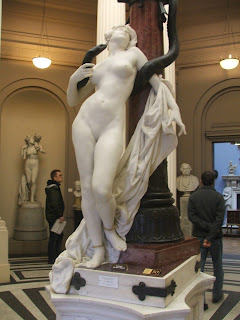
SALAMMBO: SACRED PROSTITUTION - & WHY YOU SHOULD PAY YOUR MERCENARIES

Image
SALAMMBO: SACRED PROSTITUTION - &WHY YOU SHOULD PAY YOUR MERCENARIES STATUE OF THE MONTH, MAY 2020 ‘For this woman, men would commit every sin … every sacrilege!’               (slogan on advertising poster for The Loves of Salammbo , 1960) The woman in question, Salammbo, forms the subject of a dramatic and erotic statue in the Lady Lever Art Gallery in Port Sunlight.   William Hesketh Lever, soap manufacturer and art collector, was a keen collector of contemporary sculpture; he purchased Salaambo from the artist, the French sculptor Maurice Ferrary, at the Paris Universal Exhibition in 1900 (the event for which the Eiffel Tower was constructed).   It has remained in the Lever collection ever since, forming the centrepiece of a purpose-built circular sculpture hall.                              ...

LAOCOON: STILL STRUGGLING WITH THOSE SERPENTS

Image
LAOCOÖN: STILL STRUGGLING WITH THOSE SERPENTS STATUE OF THE MONTH: APRIL 2020 In the January of 1506, a young boy called Francesco was invited to accompany his father on an unusual outing - to see some ancient statues which had just been unearthed in a vineyard on the Esquiline Hill in Rome . Francesco’s father Guiliano da Sangallo was architect to Pope Julius II, a keen collector of ancient art (he already owned the Apollo Belvedere , subject of a previous blog), and it was the Pope who had asked him to appraise this exciting new find. Guiliano decided to invite their lodger, Michelangelo (yes, the Michelangelo, and I’m not talking about the turtle) to tag along as well.   This outing left such a deep impression on Francesco that he was still able to recall the details sixty years later: ‘ When we reached the place where the statues were standing, my father said at once, “This is the Laocoön mentioned by Pliny!”        The reason Francesco’...